Stories from the Big House

14 May 2012

The House Across the Street

The Julius W. Hegeler I Home
Across the street from the Hegeler Carus Mansion in LaSalle, Illinois, stands the Julius W. Hegeler I Home designed 1904 by Pond and Pond, an acclaimed Chicago architectural firm.

The Julius W. Hegeler I Home was built for the oldest son of Edward and Camilla Hegeler.  

The fine woodwork in the entrance
of the Julius W. Hegeler I Home
The home has a distinctive English Arts and Crafts look about its brick exterior that continues inside with its spacious rooms, grand fireplaces, luxurious carved wooden staircases and fine paneling throughout.

Tile from an upstairs room
Tiles around several of the fireplaces in the Julius W. Hegeler I Home look deceptively like tiles produced by William De Morgan.
They are not!

Tile in the Dining Room
This opinion comes from Claire Longworth, Curator, De Morgan Centre, London, who after looking at images of the tiles, suggested we look at the Arts and Crafts tiles of Maw & Co. or Pilkington, both noted English tile producers of the time.
Further more, she comments, that while the tiles look to be British production, we should not rule out Belgian and even American made tiles of the period. Seems like “everyone” active in the tile business around 1900-1910 was making them in the De Morgan style or in related Arts and Crafts patterns.

Tile in the Living Room Fireplace
Further research is required and will be presented here as it happens.  Of course the most rewarding and easiest but also the most costly research route is to remove the tiles and look at their backs for possible makers marks or the name of the manufacturer. At the same time the tiles could be cleaned, conserved, and their foundation restructured and restored as needed.

Tile from a first floor fireplace
The bright red floral and the blue-green-yellow vines are based on the British Arts and Crafts styles popularized by William De Morgan (1839-1917), one of several genius designers active in the later 19th century in England. De Morgan, an English potter born in London, into a distinguished family, designed tiles, furniture and stained glass windows for his good friend, William Morris, but it is his own experimentation, mostly shortly after 1873. His interest in Persian and Hispano-Moresque patterns and glazing techniques led him to rediscover an ancient glazing technique known as luster, characterized by its highly reflective, metallic surface. This breakthrough in technology quickly inspired others, but brought De Morgan great fame with little financial success.
Moving his production facility, in 1888, from Merton Abbey to Fulham, De Morgan had the facilities to experiment with many techniques, especially the development of seemingly translucent intensely deep colors.  These brought him national, then international recognition within the Arts and Crafts Movement, but financial success remained elusive.
He stopped production of his tiles in 1904 and officially closed his factory in 1906, then selling it in 1907 to the Passenger Brothers, who had been his leading painters. At the time De Morgan wrote, “All my life I have been trying to make beautiful things and now that I can make them nobody wants them.”

Tiles in and 18th century style.
In an upstairs room of the Julius W. Hegeler House there is one fireplace surround with what look like 18th century Dutch blue and white tiles, each with a story telling scene. These, too, are most probably late 19th century or early 20th century tiles made to look like Dutch tiles.  Tiles of this type and style were very popular in Arts and Crafts homes that featured an English “country” look.  The Julius W. Hegeler House is one of these. 

More research into the tile in the Julius W. Hegeler House will follow and hopefully will eventually lead to a much clearer understanding of the use of tiles in this House and others throughout the Midwest.

The Hegeler Carus Foundation is presently raising funds to restore the Julius W. Hegeler I Home to its former glory and utilize it as a center for community arts and education.

All content contributed by Rolf Achilles.
Photographs by Kelly Klobucher of the Hegeler Carus Foundation.

21 March 2012

Spring at the Hegeler Carus Mansion

Magnolia tree in bloom
(March 18, 2012)
Spring is a beautiful time to visit the Hegeler Carus Mansion. 

Every Spring the west lawn turns blue!
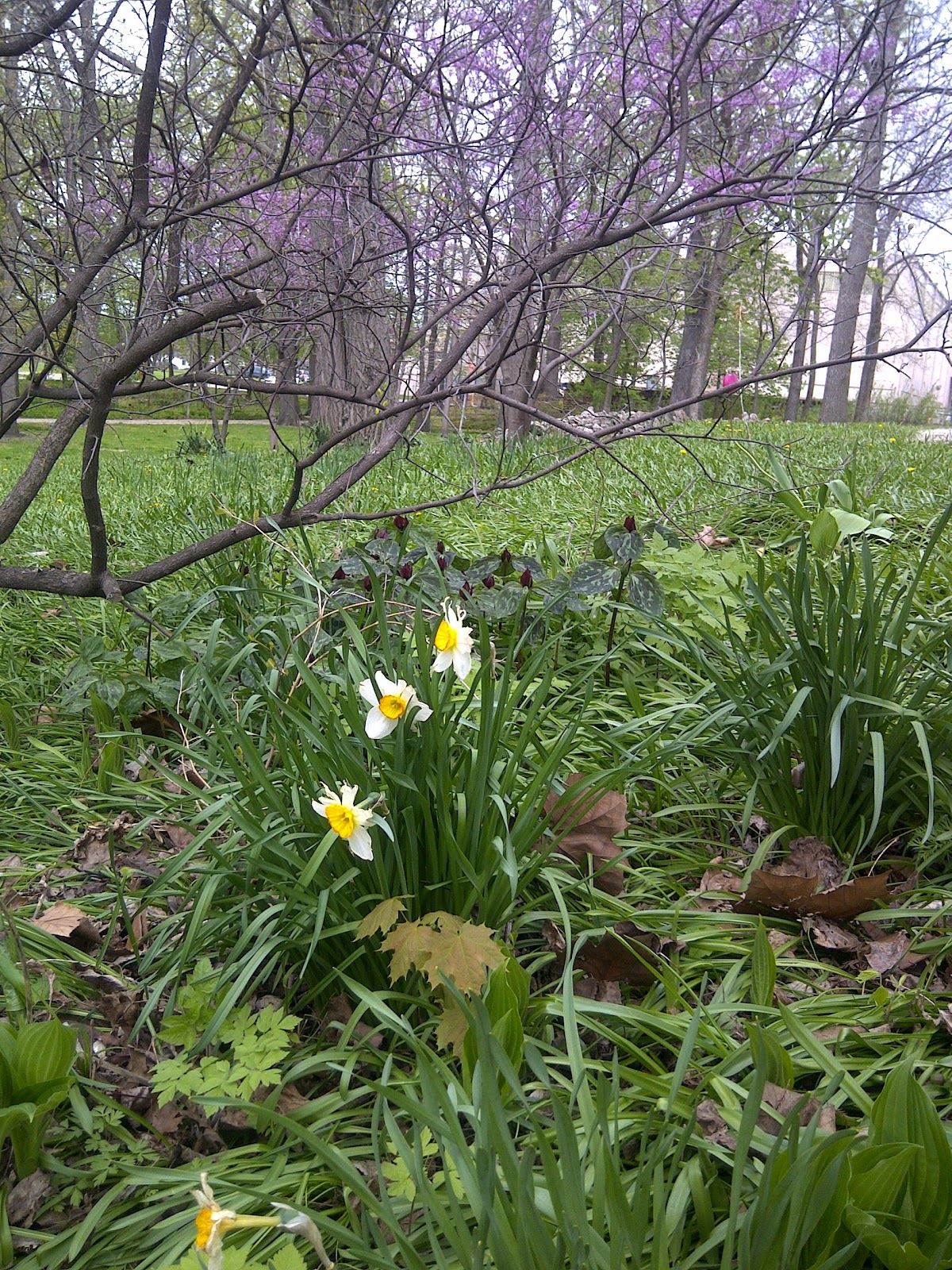
Scilla and a few daffodils blooming
(March 20, 2012)
This year we have enjoyed unseasonably warm weather and our gardens have been coming to life. 

Many plants are already in bloom.  Some are blooming a full six weeks earlier than last year.

Scilla in bloom on the west lawn
Every day we notice something new. 

We already have buds on our lilac bushes, peonies and roses.

Daffodils in bloom
(March 20, 2011)

Tulips
(March 20, 2012)
Photographs tell so much more than words, so we thought we would share some with you.

We hope to see you soon!

12 March 2012

Camilla Hegeler


Camilla Weisbach Hegeler
 On March 12 we remember Camilla Weisbach Hegeler who was born on this day in 1835.

The Matriarch of the Hegeler Family, it was she and her husband Edward who commissioned W. W. Boyington to design and build the Hegeler Carus Mansion in 1874.

Camilla was the daughter of Julius Weisbach, a Professor for applied mathematics, mining engineering, mineralogy, crystallography, mine surveying and mechanics at Freiberg Bergakademie.  Edward Hegeler was his student in 1853 and became a frequent guest in the Weisbach home. 

It was at the Weisbach home, where Edward met Camilla and the two fell in love, and made secret plans to get married-but only after Edward established an adequate position in America.

Edward left Germany in the fall of 1856 and promised his fiancée that as soon as he established a solid foothold in America he would return to Freiberg and take her "home" to his new country as his wife.

Our archives contain six letters written by Edward from La Salle to Camilla in Germany in the time span from early 1859 to early 1860.  In these letters he reports on work and his ideas. He talks of the work of starting his new company and expresses a concern that Camilla might tire of waiting for him, marry someone else and stay in Germany.  The most exuberant letter of the six was one dated 20 January 1860, in which he told her that the new plant was finally running well and that he had made travel arrangements for the long awaited trip to Freiberg to get married and take her to America, stating "One is on the earth to enjoy life, which matter should not be put off too long-it might get too late."

The wedding took place on 5 April 1860 and the Hegeler's arrived in La Salle in July of the same year.  Their family eventually included 10 children.  She adjusted quite readily to the many roles she was expected to play: as the mistress of a major household; the mother of a large family; and as a helpmate to her husband in his ambitions and aspirations.  She was very practical minded and resourceful.  She died on 28 May 1908.

The information and facts above are taken from the biography of Edward Carl Hegeler, compiled by Arno Reidies in November of 1998 and revised and edited by family members in September of 2001.

21 February 2012

Sisterly Advice: How to Treat a Lady


Page 4 of Paula's letter to her brothers
Southern Illinois University at Carbondale is home to the Open Court Archives.  Many Hegeler and Carus family letters and papers are stored, catalogued and researched at the Morris Library.

Christina Gould, located the following letter to Edward and Gustave Carus from their sister Paula Carus, giving them advice on how to treat a lady. The letter is undated so we are not sure when or for what occasion she was issuing this advice but the letter is fabulous.  Perhaps others could benefit from Paula’s advice.

Dear Edward and Gustave,
I now take a great task upon myself by writing you this letter, and because of the importance of the facts herein discussed please read it, and think carefully over all that I have said.
1.  Buy the girls’ tickets –both ways if possible—the way back (away from Madison) if not.
2.  Have rooms—the best possible and have a decent place for them to eat so that they will not have to be embarrassed by walking up and down the streets looking for an eating place.
3.  See that your clothes are in perfect order.
1. Good dancing pumps and silk black stockings. (Edward, you must see that if Gustave goes he will have these.)
2. A good evening suit—dress suit—you know the kind. A fine shirt, collar and white tie.
3.  The kind of hat necessary.
4.  Gloves, white gloves that fit.
5.  Then some kind of a coat and a white craval (I mean ruffled neck piece)
That is all I can think of along the clothes line.

Paula, Libby, Gustave and Edward Carus in 1901

Now when you meet her at the train be dressed decently. Gus should not have old shoes on but polished ones.  Your clothes should be brushed and put on strait, and you should be dressed warm enough that you do not look cold.

Then bring her to her room and be sure to introduce her to some girl—at least one.  I would be frantic if I should not meet any if I were one of your girls.  She must know one of her own sect living in the house where she is staying.  Then see that she has everything she wants. I don’t know what the custom is about supper. You will have to find out about that. You will also have to find out about the flowers.  She will need a special color to match her dress, but I don’t know just what you should do about it. Ask some other boy.  Then, don’t forget—the carriage—I suppose both of you will take one together or work it some way like that.


Paula Carus
 Then have all the dances taken that you possibly can. And see that she is introduced sometime to everyone she dances with.

I guess you know everything else to do that evening. Make some engagement with her for the next day. I don’t think you are meant to eat breakfast with her, but perhaps so. Try and do as many interesting things as you can, but also do not do anything she does not care to do.

Arrange everything very carefully with her before she comes—and be sure you know what train and also be sure that she knows where you live and who with so she will not get in the same fix that I was. –That was terrible.

Now for a very personal talk with both of you.
Please don’t get her into an embarrassing situation by anything that you do or by the way you dress. You owe to the girl (I talk in the abstract for I only know one.) that you are dressed well washed clean, no high water marks.

Don’t let her fall on the street (It is all icy, I know.) but don’t hang on to her arm too much.

Good luck to you both and please—oh please remember what I have written here and above all remember that she is a woman and you are a man—that every inch of you must be a man and show that you are in the way you treat her.

                                                                        I am, only,
                                                                                    Your loving sister,
                                                                                                Paula

20 December 2011

Holiday Lights!

Ornaments hang from the
Grand Staircase at the
Executive Mansion
This year the Hegeler Carus Mansion was invited to participate in the Historic Christmas at the Illinois’ Executive Mansion in Springfield.  The Governor's Mansion features historic flair once again this holiday season with decorations provided by Illinois museums and historic sites. 

The  Hegeler Carus Tree
in the Executive Mansion
Dining Room
The Executive Mansion is open for the public to see the decorations every Tuesday and Thursday from 9:30 to 11 a.m. and 2 to 3:30 p.m., and every Saturday from 9:30 to 11 a.m.  

Historic Christmas at the Mansion 2011” features 21 unique trees decorated by staff and volunteers from Abraham Lincoln Presidential Library and Museum, Dana-Thomas House, Old State Capitol, Vachel Lindsay Home, Elijah Iles House, Lincoln Home, Springfield Art Association – Edwards Place, and Pasfield House, all in Springfield.

Our Springfield Tree
is decorated with photos
of the Family, the Mansion,
ornaments, beautiful fabrics,
and mini Cricket magazines.


From other parts of Illinois are Lincoln’s New Salem near Petersburg; David Davis Mansion in Bloomington; Governor Duncan Mansion in Jacksonville; Quincy Museum; Hegeler Carus Mansion in LaSalle; Cahokia Mounds in Collinsville; Bishop Hill; Carl Sandburg State Historic Site in Galesburg; Bryant Cottage in Bement; Lincoln Log Cabin near Charleston;  Old Lincoln Courthouse and Museum in Beardstown; and Central Illinois Decorative Artists. 

You can visit many of these locations on the Historic Homes of Illinois website, and plan tours based on your location.
The Hegeler Carus Tree
with the Bishop Hill tree
in the background

The Executive Mansion trees were decorated by the volunteers November 25, 26 and 28 to prepare for the first public showing on November 29. 

Dried materials from the Executive Mansion gardens complement the decorated trees. 

Parlor Tree at
The Hegeler Carus
Mansion
Back home at the Hegeler Carus Mansion we are decked out for Victorian Holiday.  Our grand tree in the Parlor was decorated by some of our dedicated volunteers.  New swags were made for the mantles by our volunteers. 
This year we also added flameless candles from Batteries and Things in all of the windows and placed throughout the house to provide ambiant light for our holiday tours, parties and events.  A fireplace insert for use in the main hall was donated for the Christmas Season by Maze Lumber of Peru.

New Mantle Swag, Flameless
Candles and Fireplace
Insert
The Hegeler Carus Mansion is open for tours Wednesday through Sunday at noon, 1pm, 2pm, and 3pm.  There is a special evening tour on December 23.  Call (815) 224-5982 to make a reservation.  Check the website for holiday hours http://www.hegelercarus.org/.


01 December 2011

You are cordially invited

Edward and Camilla Hegeler
played by
Steve Seaborn and Maryhelen Bidasio
The year is 1899 and you are cordially invited to the home of Edward and Camilla Hegeler for our annual Christmas party.
This year's party promises to be great fun!

We have parlor games, music and a toast to the new century!

We have some wonderful guests visiting us this year from all over America and several friends are joining us from Germany!
Chad Brokaw as Paul Carus
Meridith Donohue as Mary Hegeler Carus
Our daughter Mary and her husband Dr. Paul Carus will co host this party with us this year.


Our guest list already includes:
 
Ida McKinley
Washington, DC
played by Carol Pratt

Karl Benz
of Ladenburg, Germany
Played by Dick Dorsch


Bertha Benz
of Ladenburg, Germany
Played by Kelly Klobucher
 
William LeBaron Jenney
of Chicago
played by Ken Ficek

Sarah Winchester
of San Jose, CA
played by Sandee Donahue
Lydia Moss Bradley
of Peoria, IL
play by Helga Interrante
Louis Comfort Tiffany
of New York
Played by John Graham


Frances Hodgeson Burnett
of Long Island New York
played by Sue Graham

Charles Gunther
of Chicago
Played by John Byrne
Madame Curie
of France
Played by Kimberly Maack

A few tickets remain for Thursday 1 December, Friday 2 December, Sunday 3 December.  Call Heather at (815) 224-5895 to reserve your space.  Tickets will not be available at the door.

09 November 2011

Alwin Carus

Most of the Stories from the Big House center around the Hegeler and Carus Families or the Mansion itself.

Alwin Carus

Today, we'd like to introduce our readers to Alwin Carus. 

Alwin was the last family member to live in the Hegeler Carus Mansion.  He is also the person to live in the mansion for the longest period of time.

Alwin was the youngest child of Mary Hegeler Carus and Paul Carus.  He was born in the Mansion on November 20, 1901 and he passed away in the Mansion on November 8, 2004-Just 12 days shy of his 103rd birthday.

In 1995 the Hegeler Carus Foundation was formed and operated in the Mansion while Alwin lived upstairs.  He was a wealth of knowledge and information and helped to guide the Foundation in the early stages of the preservation and restoration of the Mansion. 

Alwin's memories of his grandparents, Edward and Camilla, who commissioned the construction of the Mansion as well as his memory of family stories help our docents to interperet the house for our guests to this day.

He was also a benefactor for many orgaizations locally and worldwide.