Stories from the Big House

Showing posts with label Hegeler Carus Mansion. Show all posts

07 April 2015

Meet the Family

By Tricia Kelly
If we’re going to send out a blog post talking about members of the Hegeler and Carus families, it makes the most sense to start at the beginning with Mr. Edward Hegeler and continue on to the present day.
Edward C. Hegeler was born in 1835 in Bremen, Germany.  His father had visited America and believed that Edward, the youngest, should be chosen to leave his homeland and make his mark in the much newer U.S.  He attended the Polytechnic Institute in Hanover and finished his vocational education at the Technische Universitat Bergakademie in Freiberg, Saxony.  One of Hegeler’s instructors was a physics professor by the name of Julius Weisbach.  The importance of this will soon become apparent.  It was at this school where he met Frederick Matthiessen, who would later become his business partner.  Upon graduation, they both traveled to America, arriving in Boston in the spring of 1857.
After travelling some time in Pennsylvania, St. Louis, Galena, etc. Matthiessen and Hegeler found what they wanted:  good quality zinc.  And cheap, too!  See, the miners in Mineral Point, Wisconsin weren’t looking for zinc.  They were looking for lead.  And lead is under the zinc.  Zinc was simply being tossed up into huge, ‘worthless’ slag piles.  Hegeler and Matthiessen were different.  They knew that zinc ore (sphalerite), when smelted in high heat, removes impurities that, upon “rolling”, will transform into a sheet of metal that is strong, flexible, and doesn’t rust.  Those sheets of zinc could then be sent across the nation by boat or by train and made into ice box liners, pie box liners, gutters, etc.  Zinc could even be used to galvanize nails, making them rust proof.  But from where would the fuel be obtained to burn a heat high enough for smelting?  Well, that’s where La Salle comes in.  Huge, rich coal deposits.  Bring up two tons of coal, smelt one ton of zinc, and blammo! 
Zinc wasn’t the only thing on Hegeler’s mind.  In 1860 he married Camilla.  Camilla Weisbach.  Sound familiar?  As the daughter of Hegeler’s professor, Camilla was intelligent, well-educated, outspoken, and honest—traits which Hegeler greatly admired.
By the time construction of the Mansion began in 1874, the M & H Zinc Co. was the nation’s leader in zinc production.  In addition, Camilla Hegeler had given birth to nine of their ten children.
Fast forward to 1887, when men of science began taking a look at religion.  A renaissance of religious fervor began during the bloodiest days of the American Civil War, and people like Darwin were shaking up the ideas of creation.  Hegeler, like many of his contemporaries, began looking at religion from a scientific point of view and opening discussion to the precepts of other religions, particularly those of Eastern influence.  It should be noted that Edward Hegeler was not at all interested in the fast-growing new ‘religion’ of Spiritualism.  In 1887, he founded the Open Court Publishing Company with the idea that anyone could discuss any type of religion and not be judged by anyone—in other words, an open court for dialogue.  He hired Dr. Paul Carus (who will be discussed in another blog) to be the editor, edging out the frustrated, increasingly spiritualist Underwoods.

Edward Hegeler passed away in 1910, age 74.  He is today remembered and respected as one of the true pioneers of American industry.

31 March 2015

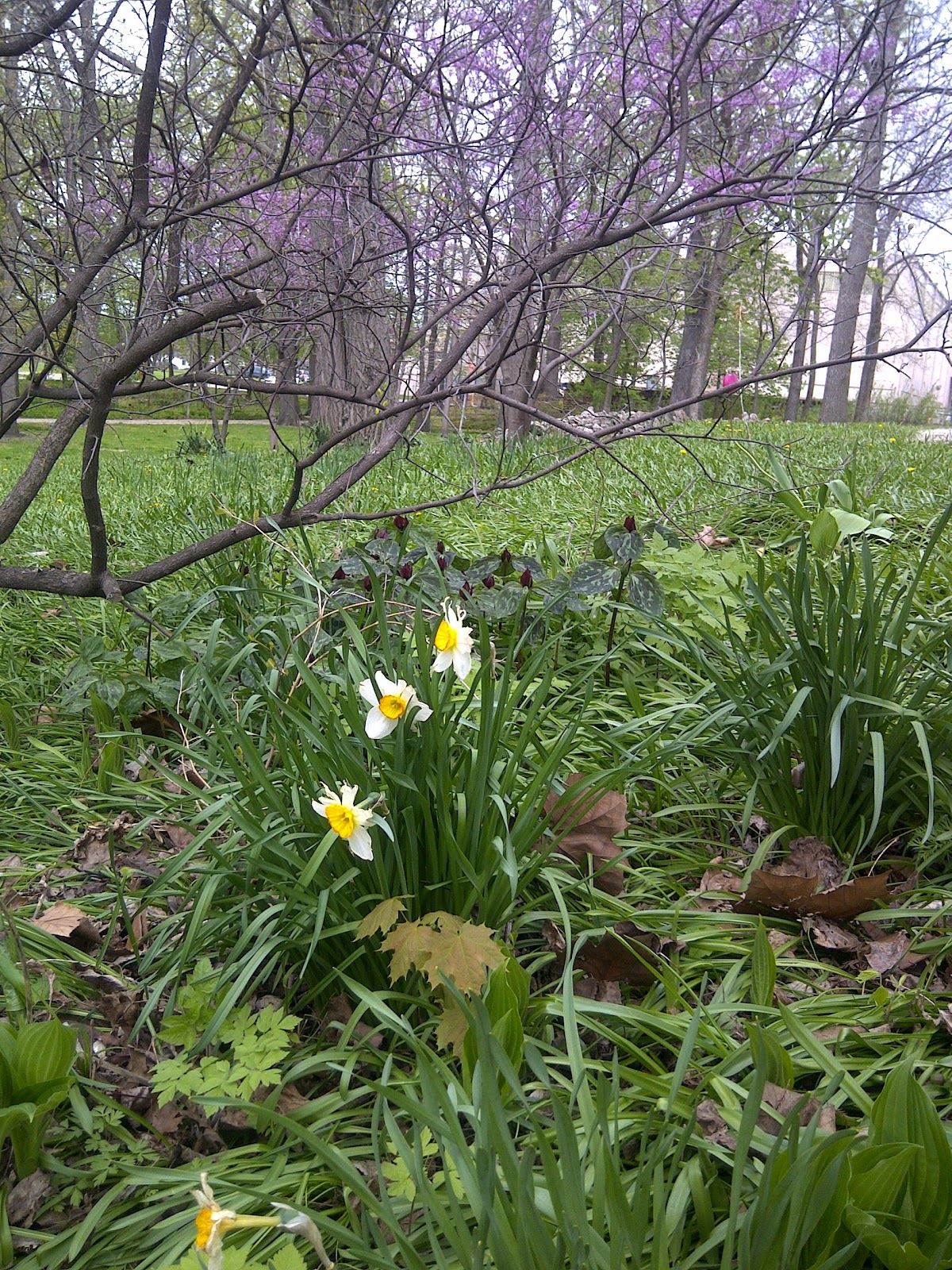
Spring is here!

This was taken in the spring of 2013.  Follow us on Facebook
to see what's blooming this week at the
Hegeler Carus Mansion.
Spring is here, and it finally feels like the weather is going to improve.  We have endured what seemed like an endless winter.  On a positive note, we have accomplished a great deal while we've been cooped up indoors.

First of all, we have improved our website.  It is now easier to navigate and it will be easier than ever to plan a trip to visit the Mansion.  Of course, you are always welcome to call us.  We are happy to help curate your trip and love to make recommendations about our favorite local places to stay, shop, eat and explore.

Secondly, we are writing more for this blog.  There is SO MUCH information about this house that we simply cannot cover in a 50 minute tour.  Tour Director Tricia Kelly has been researching and writing about Victorian customs, objects in the Mansion and many other topics.  We will begin posting her articles soon.  We will also post some "throw back Thursday" items here and also on our Facebook page so you can see old photos of the house.

Of course, we have also planned a great summer full of events that you will not want to miss!  Be sure to follow this blog, like us on Facebook, and check  the event page on our website for up to date information on what we have planned.

We look forward to seeing you soon!

10 January 2013

Mary Hegeler Carus


Mary Hegeler Carus was born on January 10, 1861 in a two-story frame dwelling which was located on the grounds of the M and H. Zinc company, founded by her father and F. W. Matthiessen three years earlier.   After the family moved from the home in which she was born to the Mansion, it was used for as the general office of the firm.
Mary Hegeler married Paul Carus
in 1888 at the
Hegeler Carus Mansion.
 Her parents were Edward C. Hegeler and Camilla Weisbach Hegeler, who commissioned the construction of the Mansion in 1874.  Both of her parents were natives of Germany. Her mother was the daughter of Julius Weisbach who was the head of the School of Mines at Freiberg, Saxony, Germany, which Mary later attended.

After studying in local schools, including the La Salle City high school, which was located on Third and Tonti street, Mary entered the University of Michigan and graduated from that institution in 1882.  She was the first woman ever to receive a B. S. degree in engineering at U of M. From there, she went to Germany and did post-graduate work at the Freiberg school, which at that time was one of the world’s three outstanding mining schools.
When she returned to the United States, she became closely associated in the operation of M&H Zinc and throughout her lifetime she maintained an intimate contact with all the phases of operation at that plant, having served as president of the company from 1903 to 1917, succeeding her father upon his retirement from that office, as secretary from 1917 to 1933 and again as president from 1933 until her death in 1936.

Throughout her lifetime Mary avoided frills, always content with only the fundamentals of living. Hers was a life dedicated to doing things for her fellow man and scores of her works of benefaction never came to public light. She found keen satisfaction in making life easier for others by giving quietly, a trait that many of her children and grandchildren have followed today.
 
She is remembered lovingly by the hundreds of young men from the area who served their country in World War I, for through her each received a warm, woolen blanket before entraining for camp. The first of these blankets was made by her and her friends in the Mansion.  When the draft increased, it became impossible to continue supplying home-made blankets, so Mary met the situation by buying blankets and directing the distribution of them.

Mary also initiated the first classes in sewing for girls and in manual training for boys, financing this project for many years before the local board of education absorbed domestic science and manual training in the school curriculum.

The information above is taken from her Obituary, which was published in 1936.  For more information on Mary Hegeler Carus, visit the Hegeler Carus Mansion in La Salle, IL. 

18 July 2012

160 years of Paul Carus

 
Paul Carus
Paul Carus was born 18 July 1852 in Ilsenburg, Germany. In 1887, he moved to America and soon after became the Editor-in-Chief of Open Court Publishing in La Salle, IL. In that role, he corresponded with and published the works of leaders in the fields of mathematics, philosophy, world religions, and related disciplines. 

Mary Hegeler Carus
and Paul Carus
1888
He married Mary Hegeler in 1888 and lived in the Hegeler Carus Mansion for the rest of his life.

During his lifetime, Carus published 75 books and 1500 articles, mostly through Open Court Publishing Company. He wrote books and articles on history, politics, philosophy, religion, logic, mathematics, anthropology, science and social issues of his day.
In addition, Carus corresponded with many of the greatest minds of the late 19th and early 20th century. Carus made a copy of the letters he sent, and kept them with those he received as a record of complete correspondence.  These letters from great thinkers of his time, such as Leo Tolstoy, Thomas Edison, Nichola Tesla, Booker T. Washington, Elizabeth Cady Stanton, Ernst Mach, Ernst Haeckel, John Dewey, and many more are now archived in the Special Collections at the Morris Library of Southern Illinois University, Carbondale.
The World Parliament of Religions-1893
In 1893, Carus offered a thirty-minute talk at the Parliament of World's Religions, which was held in conjunction with the World's Fair and Columbian Exposition in Chicago.  He later wrote that he never expected to be so moved by this event, which was the first time all known religions were brought together.  He spent the remainder of his life working to
build understanding between different religions.
In 1894, Dr. Carus wrote The Gospel of Buddha, the classic text on Buddhism that first introduced many Westerners to Buddha and his teachings. Because it was written in chapter and verse like the Christian "gospels," it was easily understood by Christian audiences who were unfamiliar with Buddhists teachings.

Dr. Carus' passion and commitment to the quest for religious and spiritual understanding was illustrated by his lifelong dedication to providing an open forum for the ideas of such diverse scholars as Pierce, Russell, Mach, Dharmapala, Swami Vivekananda, Shaku Soyen, D.T. Suzuki, and thousands of other great thinkers. As a thinker, writer and publisher, Carus became a bridge-builder between religions and science, philosophy and society, and Buddhism and Christianity.  
The legacy of Paul Carus is honored through the efforts of the Hegeler Carus Foundation, the Paul Carus Award for Interreligious Understanding  by the Council for a Parliament of the World's Religions (CPWR) and through Open Court Publishing, which is still operated by the Carus Family and specializes in scholarly and trade non-fiction, with an emphasis on philosophy, social issues, Eastern thought, education, psychology, Jungian analysis, and religion and science.

For more information on Paul Carus, the Parliament of World's Religions, The Hegeler Carus Mansion and the 1893 World's Fair and Columbian Exposition we suggest the following books, available at our gift shop.

The Gospel of Buddha
Catalyst for Controversy
The Devil in the White City (fiction)
Patina of Time


21 March 2012

Spring at the Hegeler Carus Mansion

Magnolia tree in bloom
(March 18, 2012)
Spring is a beautiful time to visit the Hegeler Carus Mansion. 

Every Spring the west lawn turns blue!
Scilla and a few daffodils blooming
(March 20, 2012)
This year we have enjoyed unseasonably warm weather and our gardens have been coming to life. 

Many plants are already in bloom.  Some are blooming a full six weeks earlier than last year.

Scilla in bloom on the west lawn
Every day we notice something new. 

We already have buds on our lilac bushes, peonies and roses.

Daffodils in bloom
(March 20, 2011)

Tulips
(March 20, 2012)
Photographs tell so much more than words, so we thought we would share some with you.

We hope to see you soon!